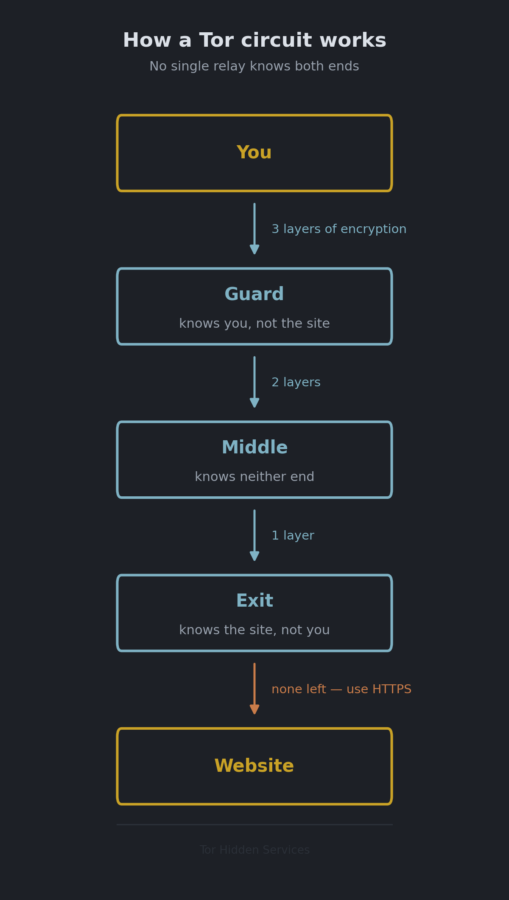
Tor makes it hard for anyone watching your connection to see which sites you visit, and hard for those sites to see who you are or where you’re sitting. It does this by bouncing your traffic through three volunteer-run computers before it arrives anywhere, wrapped in layers of encryption that come off one at a time. Most people meet it through Tor Browser, which you download and open like any other browser.
That’s the short version. The rest of this assumes you’ve heard the name and never used it.
What problem is this solving?
Open an ordinary website and two parties learn something about you.
Your internet provider sees which site you asked for. Encryption protects what you read once you’re there, but not the fact that you knocked on the door. Across much of Europe providers are obliged to keep those records for months, whether they want to or not.
The site itself sees your IP address. That’s a number your provider hands you, and it gives away your rough location and which company you buy internet from. Sites use it to guess your city and to recognise you when you come back.
None of that matters most of the time. Sometimes it matters a great deal. A journalist taking a call from a source. Someone reading about a diagnosis they haven’t told anyone about. Someone in a country where certain books are a problem. Someone working out how to leave a relationship while the other person still has access to the router.
How it works, without the jargon
Say you want to post a letter. The recipient shouldn’t learn your address, and the postal service shouldn’t learn who you’re writing to.
So you write the letter, seal it, and address it. Then you put that envelope inside another one addressed to a stranger, and that inside a third addressed to a different stranger. You hand the bundle over.
The first stranger opens the outer envelope. Inside is just another envelope with someone else’s name on it, so they pass it along. Second stranger, same thing. The third opens the last one and posts your letter.
Nobody in that chain holds both halves of the secret. The first knows you but not where it’s going. The last knows where it’s going but has no idea who started it. The one in the middle knows nothing at all.
Tor works like that. The strangers are relays — several thousand machines run by volunteers who mostly don’t know each other. Your traffic crosses three of them. The first is the guard, which sees your real address. Then a middle relay, blind at both ends. Then the exit, which does the actual talking to the website and hasn’t a clue who you are.
That three-hop path is a circuit. Your software tears it down and builds a new one periodically, so your whole day doesn’t travel the same road.
The onion part
Tor originally stood for The Onion Router. The name is about those envelopes.
Your traffic gets encrypted three times over, once per relay, in layers. Each relay strips exactly one layer, and underneath finds only an instruction about where to pass the bundle next. It can’t read any deeper. You work inward one layer at a time, and no single relay is ever handed more than its own.
Tor Browser is not Tor
Nearly everyone gets this muddled at first.
Tor is the network — relays, circuits, encryption. Tor Browser is a piece of software that uses it, built on Firefox by the Tor Project. People say both names to mean the same thing, which is understandable and still wrong.
The browser does a second job that has nothing to do with routing. Websites can pick you out of a crowd using small details of your setup: window size, which fonts you have installed, your time zone. It’s called fingerprinting, and it means hiding your IP address achieves very little if your browser is one of a kind. So Tor Browser flattens all those details, deliberately, to make its users interchangeable.
Which is why the standing advice is to leave it alone. Don’t resize the window, don’t add extensions, don’t improve the settings. Every tweak makes you more distinctive, and distinctive is precisely what you don’t want. The installation walkthrough goes through this, along with the part that matters more than installing — getting hold of a genuine copy.
What it protects
- Your provider can tell you’re using Tor. It cannot tell what you’re doing with it.
- Sites see the exit relay’s address instead of yours, so your location and your provider stay out of it.
- Tor Browser blocks and clears most of the machinery advertisers use to follow people between sites.
- Where Tor itself is blocked, unlisted relays called bridges can usually get you through.
What it doesn’t
Pay more attention to this list than the one above it. People who come to grief on Tor are almost never undone by the network. They’re undone by something here. What Tor hides and what it doesn’t takes each one apart properly.
- Telling a site who you are. Log into an account with your name on it and you’ve answered the question the network was protecting. Routing can’t unring that bell.
- Unencrypted connections at the exit. The exit relay has to read the address it’s contacting. If the connection to the site isn’t itself encrypted, it can read everything else too. Look for the padlock.
- Downloads you then open. A file is harmless sitting on your disk. Open it outside the browser and it can phone home on your real connection. Old trap, still catching people.
- Your own machine. Tor protects a connection. Malware that’s already on your computer reads what you type before the network ever sees it.
- Very well-resourced observers. Someone able to watch traffic going into the network and coming out of it, simultaneously, may be able to match the timing. Known limitation, actively researched, not solved.
- Being yourself. Your turn of phrase, the hours you keep, the things you can’t help mentioning. No amount of routing touches any of that.
Tor is strong against surveillance of the network and weak against your own habits. Most of the frauds that keep working live in that gap rather than in the technology.
Is it legal?
In most places, including the US, the UK and the EU, yes — plainly and unambiguously. It’s a privacy tool. Newspapers use it, universities use it, human rights organisations use it, and so do police forces.
Some countries block it. A handful treat using it as inherently suspicious. And the obvious caveat holds: Tor changes the route your traffic takes, not the law. Anything illegal without it stays illegal with it.
Who’s actually on it
Around three million people connect on an average day, and the popular picture of who they are is badly wrong.
Newspapers run confidential tip lines on it. Whistleblowing platforms are built on it. Researchers use it to see what a website shows people in other countries. People under censorship use it to read ordinary news. Organisations working with domestic abuse recommend it to people whose phones and accounts are being watched. And a large number of users are simply private people who’d rather their provider didn’t keep a list.
Criminal use is real and thoroughly documented. Pretending otherwise would be silly. But it’s a slice of the thing, not the thing, and judging the whole network by it tells you about as much as judging the post office by what fits in a padded envelope.
What using it feels like
Worth knowing in advance, because it surprises people.
Slower. Three hops through volunteer machines, many of them unremarkable hardware. Pages take seconds instead of appearing instantly. Video is often a struggle.
Sites don’t trust you. Exit relays are shared by lots of people, so from a website’s perspective an enormous amount of traffic arrives from a handful of addresses. Expect to be asked to prove you’re human, repeatedly. Some sites just refuse. This has got considerably worse over the last decade.
Things break. Anything relying on the tracking Tor Browser blocks tends to stop working.
None of that is a fault. It’s the price of the design, and knowing it beforehand is the difference between thinking the thing is broken and understanding the trade you’ve made.
A word about onion services
You may have run into addresses ending in .onion. Those are onion services — sites living inside the Tor network rather than on the ordinary web, reachable only through it. They’re where this site gets its name, and they work quite differently from everything described above. Separate topic.
Next
The obvious follow-ons are what Tor hides and what it doesn’t, which goes deeper into the limits, and installing Tor Browser, which is fiddlier than it sounds for reasons that have nothing to do with the installer.
If you take one thing away: Tor hides the route. It doesn’t hide what you choose to say, download, or log into.